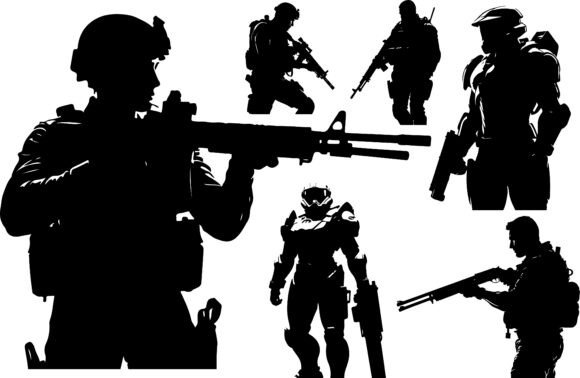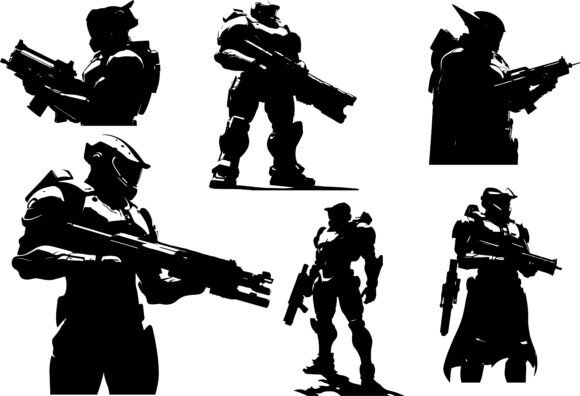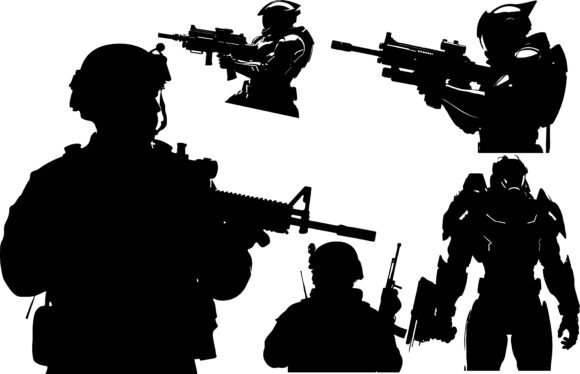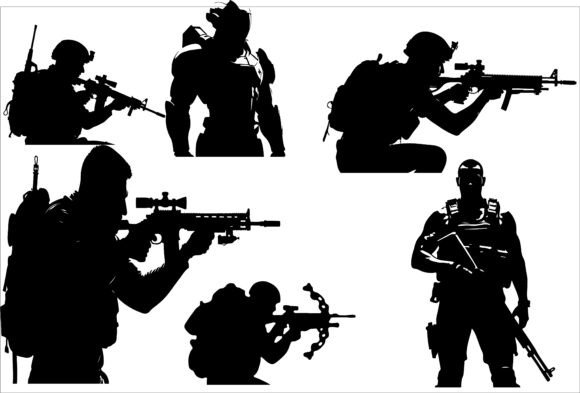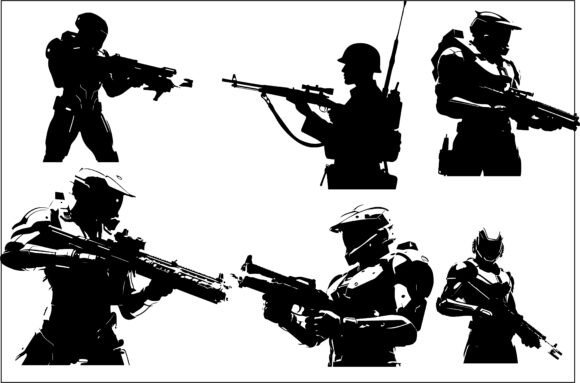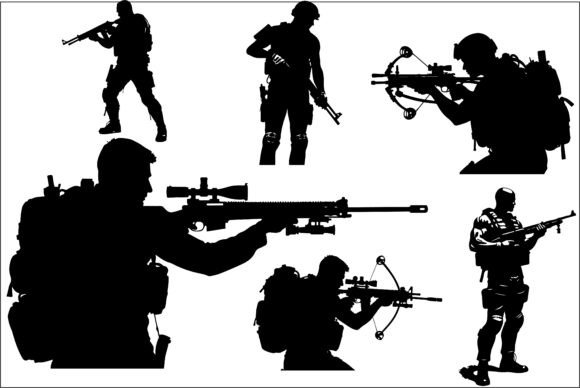
Tactical Soldier Sci-Fi Warrior 4: A Workhorse Asset for Designers and Makers
Every creative professional working in tactical or sci-fi design has faced the same bottleneck: sourcing high-fidelity assets that don’t require hours of manual cleanup or redrawing. Whether you are building assets for a video game, preparing a batch of laser-engraved products, or designing a military-themed apparel line, the quality of your source material determines the speed of your entire production pipeline. Tactical Soldier Sci-Fi Warrior 4 is a targeted response to that bottleneck—a bundle of battle-ready silhouettes engineered for immediate integration across digital, print, and fabrication workflows.
This article is not a simple feature list. It is a practical walkthrough of how this asset pack fits into real creative processes, from pre-production planning and format selection to final output and long-term library management. If you are serious about reducing grunt work and increasing output consistency, these are the implementation strategies that matter.
Strategic Asset Sourcing Before the First Click
The most efficient workflows begin before a single file is opened. High-performing creators do not start by drawing. They start by auditing their existing assets against the project brief. If you are designing for an FPS game, a tactical gear brand, or a CNC fabrication project, you need a library of poses that match the intensity and posture of your target audience. Tactical Soldier Sci-Fi Warrior 4 provides a curated set of silhouettes that eliminate the need to scour stock sites or hire a digital artist for basic poses.
When evaluating this bundle for a project, focus on three planning factors:
- Pose Rigging and Clarity: Silhouettes must be readable at small scales. Check that limb angles, weapon profiles, and equipment outlines are distinct and unambiguous.
- Format Coverage: Your prep phase should confirm that the pack includes the exact file types your software stack demands. This bundle covers PNG for web mockups, SVG for vector scalability, EPS for professional print workflows, and DXF for CAD and fabrication tools.
- Licensing Hygiene: Understanding your commercial use rights before purchasing prevents workflow interruptions later. Ensure the license allows for the specific volume or distribution model you plan to use.
Integrating this prep step into your standard operating procedure means you never waste a project day hunting for assets or wrestling with incompatible file formats. You simply slot the right pack into the right project slot.
Format Deep Dive: Matching Assets to Output Channels
A common workflow mistake is treating all vector files as interchangeable. They are not. Each format in Tactical Soldier Sci-Fi Warrior 4 serves a distinct function in a professional production chain. Understanding these roles helps you maintain technical quality from concept to final delivery.
SVG for Digital Flexibility and Scalability
SVG is the most versatile format in this bundle for digital design. It scales to any resolution without quality loss, making it ideal for building responsive web assets, UI elements, or game sprites. In tools like Figma, Illustrator, or Inkscape, SVG files retain their editable anchor points. This lets you quickly modify a silhouette’s stance, remove equipment, or combine multiple poses into a single composition. Keep an organized SVG library in a shared cloud folder for easy team access.
EPS for Professional Print and Production
Print workflows rely on stable, high-fidelity vector files that handle CMYK color separation and spot channels correctly. EPS is a battle-tested format for screen printing, offset printing, and large-format output. When you import the EPS files from this bundle into Adobe Illustrator or CorelDRAW, you can immediately adjust stroke weights, create halftones, or separate layers for different ink colors. This is critical for apparel printing, where proper layer separation reduces setup time on the press.
DXF for Precision Fabrication
For makers and fabricators, DXF is the bridge between design and physical output. CNC routers, plasma cutters, and laser engravers rely on clean, closed vector paths. The DXF files in Tactical Soldier Sci-Fi Warrior 4 are optimized to prevent open contours, which cause failed cuts and wasted material. Importing these directly into LightBurn, Fusion 360, or Carbide Create means you can focus on toolpath optimization instead of path repair.
PNG for Speed and Raster Rendering
Sometimes you need a ready-to-use bitmap. High-resolution PNG files are perfect for quick mockups, social media assets, in-game sprite placeholders, or whenever you need transparent backgrounds without dealing with vector rendering issues. Ensure your project uses 300 DPI for print and 72 DPI for web to maintain sharp edges.
Practical Implementation Scenarios
The true test of any asset pack is how well it performs inside your existing tools and processes. Here are three common workflows where Tactical Soldier Sci-Fi Warrior 4 can be integrated immediately.
Apparel Printing and Merchandise Production
If you run a print-on-demand store or a screen-printing shop, your turnaround time depends on how fast you can prepare artwork for the press. After downloading the EPS files, import them into your vector editor and apply a rough, distressed effect using the built-in filters or custom brushes. Separate the main silhouette from background elements into distinct layers for multi-color prints. Because the silhouettes are already high-contrast and well-defined, you can skip the tracing step entirely. This cuts your prep time per design from 45 minutes to under 10 minutes.
Game Development and Interactive Design
Indie game developers, especially those building tactical shooters or sci-fi strategy titles, need recognizable silhouettes for player feedback. Enemy units must be readable at a glance. Import the SVG files directly into Unity via the Vector Graphics package or into Godot as resource files. Use the PNG files for sprite sheets if you are working on a 2D pixel-art hybrid style. The consistent style across poses ensures that your units look like they belong to the same faction without requiring an artist to redraw each angle.
CNC Routing and Laser Engraving
For makers producing custom phone cases, signs, or props, the DXF files are the most valuable assets in the pack. Open the DXF in your fabrication software, scale it to your material dimensions, and run a test cut on scrap. The closed vector geometry reduces the risk of the laser skipping sections or the CNC bit veering off path. For laser engraving, use the high-contrast PNG as a mask, or invert the SVG to burn the background around the soldier silhouette for a striking negative-space effect.
Quality Control and Pre-Flight Checks
Even the best asset packs benefit from a brief verification step before full production. Building a lightweight quality control checklist into your workflow protects you from downstream errors.
- Check Anchor Points: Open one SVG and one EPS file in your vector editor. Verify that the anchor points are clean and that no extraneous points exist from a faulty export. The files in Tactical Soldier Sci-Fi Warrior 4 are generally clean, but always verify before batch processing.
- Scale Verification: Ensure the artboard or canvas size matches your project specifications. A silhouette designed for a 12-inch t-shirt print might need resizing for a business card or a billboard. Use proportional scaling to preserve aspect ratios.
- Test Cut Paths: For DXF use, run a simulation in your CAM software or a quick air-fire test with the laser. Look for overlapping lines or tiny gaps that can cause incomplete cuts.
- DPI Consistency: If you are mixing multiple PNG assets, standardize the DPI. Mixing 72 DPI and 300 DPI images in the same print layout can lead to unexpected scaling shifts.
Embedding these checks into your routine maintains professional output quality and prevents material waste.
Building a Long-Term Asset Library
A single project might only use a handful of poses. The real ROI of Tactical Soldier Sci-Fi Warrior 4 comes from treating it as a long-term library asset rather than a one-time purchase. Creators who maintain a structured digital asset library can pull from these silhouettes years later for entirely different campaigns.
Organize your library by theme, format, and resolution. For example:
- /Assets/Tactical/Soldier/SVG/
- /Assets/Tactical/Soldier/EPS/
- /Assets/Tactical/Soldier/DXF/
- /Assets/Tactical/Soldier/PNG_300dpi/
This structure allows you to batch process files, quickly locate the exact pose you need, and share specific folders with team members without exposing unrelated assets. Over time, as you combine this pack with other tactical elements like vehicles, weapons, and UI components, your library becomes a custom visual language for your brand or studio.
Collaboration and Team Integration
For design leads and creative directors, standardizing asset sources across a team improves coherence. When every artist or fabricator pulls from the same high-quality bundle, the resulting work shares a consistent aesthetic. Pushing the Tactical Soldier Sci-Fi Warrior 4 files to a shared server or cloud drive with version control ensures that everyone works from the same baseline.
During onboarding, brief your team on the exact folder locations and naming conventions. Demonstrate how the SVG files can be edited without breaking paths and how the DXF files should be handled in the CAM software. This upfront investment in asset literacy pays for itself by reducing back-and-forth revisions and misaligned output.
If you are a freelancer delivering assets to a client, including the modified EPS or SVG files from this bundle in your deliverables gives the client editable source files they can adapt for future needs. This type of professionalism builds trust and leads to repeat engagements.
Efficiency Without Sacrificing Originality
Some creators worry that using pre-made silhouettes limits their creative control. In practice, the opposite is true. By offloading the time-intensive task of drawing accurate, battle-ready poses to a dedicated asset pack, you free up your mental bandwidth for higher-order design decisions. You can focus on custom environments, unique color palettes, innovative layout compositions, and branding elements that differentiate your work.
The Tactical Soldier Sci-Fi Warrior 4 bundle gives you a reliable foundation. You can overlay custom insignia, adjust weapon profiles, or merge multiple silhouettes into dynamic combat scenes. The asset is a starting point, not a crutch. Used correctly, it amplifies your creative output without dictating it.
From prep and sourcing to final production and long-term reuse, integrating this pack into your workflow is a decision that compounds in value. Each project gets easier to start, faster to execute, and more consistent in quality. That is the mark of an asset that belongs in every serious creator's toolkit.