Why the Professional Soldier Silhouette Belongs in Your Creative Toolkit
You have likely seen it a hundred times without really noticing it. That clean, sharp outline of a soldier in combat gear, standing against a sunset, crouched with a rifle, or moving in tactical formation. The Professional Soldier Silhouette is one of those rare visual assets that feels both timeless and immediately recognizable. Whether you are designing a logo for a veteran-owned business, building the interface for a tactical shooter game, or putting together a recruitment poster, that single silhouette can say more than a full-color photograph ever could. Let us walk through what this asset actually is, why it works so well across different fields, and how real people are using it right now to get better results.
What Exactly Is a Professional Soldier Silhouette?
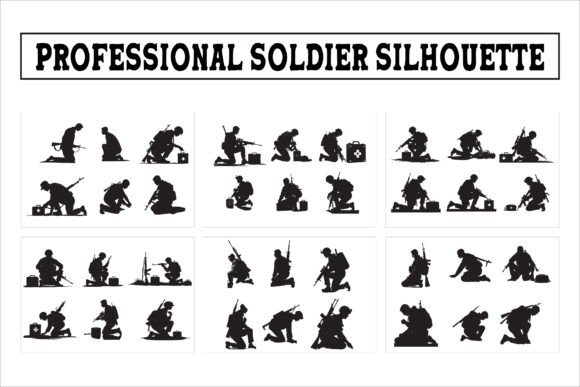
At its core, a Professional Soldier Silhouette is a vector-based or raster graphic that depicts the outline of a soldier in a posed or active stance. The 6 Set EPS Files, 6 Set SVG Files, 6 Set JPG Files, and 6 Set PNG Files included in a typical package give you flexibility across nearly every design platform. The EPS and SVG formats allow for infinite scaling without losing quality, which matters when you are blowing up a silhouette for a banner or shrinking it down for a business card. The JPG and PNG versions are ready for immediate use in web projects, social media graphics, or print layouts.
What makes these silhouettes so effective is their simplicity. By stripping away facial features, uniform details, and background clutter, you get a universal symbol that represents discipline, strength, and purpose. Different poses communicate different moods. A standing silhouette with a weapon at rest feels authoritative and grounded. A crouched or running silhouette conveys action and readiness. A saluting figure evokes respect and ceremony. Having multiple poses in one set means you can match the tone of your project without needing to commission custom artwork.
Graphic Design and Branding: Where First Impressions Are Everything
If you work in graphic design, you already know that the difference between a forgettable logo and an iconic one often comes down to shape recognition. A Professional Soldier Silhouette gives you a shape that people process instantly. That is why you see these outlines used so heavily in branding for military, tactical, and security companies.
Consider a small firearms training academy trying to build a brand on a tight budget. Hiring an illustrator to create a custom mascot or emblem could cost hundreds or thousands of dollars. With a well-chosen soldier silhouette, the designer can place it inside a circle or shield, add a company name in bold sans-serif type, and have a professional logo in under an hour. The silhouette does the heavy lifting. It signals to potential customers that this business is serious, tactical, and rooted in military culture.
The same logic applies to airsoft and paintball fields, survival gear manufacturers, and even outdoor apparel brands targeting the tactical lifestyle market. A silhouette on a website header or product packaging immediately communicates the vibe of the brand. It saves you from having to explain what you are about. People see the shape, and they already know.
One observation worth noting: silhouettes work especially well in monochrome branding. A black or white soldier outline against a contrasting background keeps the visual clean and scalable. If you are designing a patch or embroidery, a silhouette with clear, unbroken lines translates beautifully into thread. The simplified shape means the embroiderer can capture the detail without losing the form.
Apparel and Merchandise: Wearing Identity
Walk into any military surplus store, veteran-owned coffee shop, or tactical gear expo, and you will see apparel covered in soldier silhouettes. T-shirts, hoodies, caps, and patches all feature these outlines prominently. Why? Because people want to wear something that reflects their identity without being overly literal or flashy.
A silhouette printed on a shirt can be subtle enough for casual wear but still bold enough to make a statement. For a brand selling to veterans, first responders, or military enthusiasts, a soldier silhouette on a hat or patch creates an instant connection. It is a visual handshake. It says, "I get it."
Stickers and mugs also benefit from the silhouette approach. A simple outline on a matte black mug or a die-cut sticker can look premium without requiring complex artwork. For small businesses that sell at gun shows, airsoft events, or online through platforms like Shopify or Etsy, having a set of six different poses means you can rotate designs seasonally. One pose works for a "Veterans Day" drop, another works for a "Tactical Training" line, and a third fits a "Memorial" collection.
Patches are another area where silhouettes truly shine. Because patches are embroidered, too much detail turns into a muddy mess. A clean soldier outline with distinct edges holds up well during stitching. The result is a patch that looks crisp even from a distance. Many custom patch companies recommend using vector silhouettes for exactly this reason.
Marketing and Promotions: Grabbing Attention at a Glance
Marketing materials for military events, recruitment drives, and veteran organizations need to grab attention fast. People scrolling through social media or walking past a bulletin board are not going to stop and read paragraphs of text. They need a visual hook. A Professional Soldier Silhouette provides that hook.
Posters and flyers for a tactical training program, for example, can use a large silhouette in the background with a bold headline overlaid. The silhouette sets the tone immediately, allowing the copy to focus on dates, locations, and registration details. You do not need a stock photo of a soldier looking intense. The silhouette does the job without distracting from the message.
Banners for fundraising events, 5K runs, or charity galas also benefit. A row of silhouettes in different poses across the bottom of a banner creates a visual rhythm that feels cohesive and professional. For recruitment materials, a saluting silhouette can evoke patriotism and duty without crossing into cliché.
One practical consideration: when printing banners or large-format posters, vector files become your best friend. The EPS format from your set allows you to scale the silhouette to any size without pixelation. A silhouette that looks sharp on a business card will look equally sharp on a 10-foot banner. That is the kind of flexibility that saves designers from having to recreate assets for different formats.
Gaming and Digital Media: Building Atmosphere Efficiently
Game developers, especially those working on indie titles or mobile apps, face constant pressure to produce high-quality assets with limited resources. A Professional Soldier Silhouette can serve multiple roles in a game project without requiring a dedicated 3D modeler or texture artist.
In a military-themed video game, silhouettes can be used for UI elements like health bars, minimap icons, and loadout screens. A small silhouette icon next to a player's username or squad number adds thematic consistency. For wallpaper designs or loading screens, a large silhouette against a gritty, desaturated background sets the mood without needing a full illustration.
Mobile games, in particular, benefit from silhouettes because screen real estate is limited. A detailed soldier avatar may be too small to read on a phone screen. A silhouette, by contrast, remains identifiable even at small sizes. Some game developers use soldier silhouettes as placeholders during early development to test art direction before commissioning final assets. This approach saves time and money during the prototyping phase.
Beyond games, digital media creators use silhouettes in social media graphics, YouTube thumbnails, and presentation decks. A thumbnail featuring a bold soldier outline against a fire or smoke background performs well because it is visually striking and immediately communicates the content's theme. For Twitch streamers who focus on tactical shooters, a silhouette in their overlay or channel art reinforces their niche.
Educational and Informational Materials: Clarity Over Decoration
Historians, educators, and military authors often need illustrations that support learning without creating confusion. A Professional Soldier Silhouette works well in textbooks, training guides, and infographics because it provides visual clarity. When you are illustrating military formations, rank structures, or historical battle tactics, a silhouette allows the reader to focus on the concept rather than getting distracted by uniform details or facial expressions.
For example, a training manual for a tactical response team might use silhouettes to show proper search procedures, room clearing formations, or movement techniques. The silhouette keeps the illustration generic enough that it applies to any team member, regardless of body type or equipment variations. It also avoids potential issues with showing identifiable features in official materials.
Infographics about military history, weapon systems, or strategy benefit from silhouettes of different sizes and poses. You can create a visual hierarchy where larger silhouettes represent key figures or units, and smaller silhouettes show supporting elements. This non-verbal communication helps readers absorb information faster than text alone.
One limitation to consider: if your educational material requires showing specific equipment, gear, or uniform details unique to a particular era or branch, a generic silhouette may not be sufficient. In those cases, you would want a more detailed illustration or photograph. But for broad concepts, tactical principles, or comparative analysis, the silhouette remains unmatched in versatility.
Common Considerations Before You Choose a Set
Not every silhouette set is created equal. Before you download a set of six EPS, SVG, JPG, and PNG files, think about your specific use case. The pose variety matters. If you are designing for a solemn memorial event, a silhouette with a weapon may feel inappropriate. You might instead choose a saluting or standing-at-attention pose. Conversely, if you are designing for a tactical training advertisement, a crouched or moving pose communicates energy and readiness.
File resolution is another factor. The JPG and PNG files in a good set should be high enough resolution for web use and small print, but the real power comes from the EPS and SVG vectors. These allow you to resize without limits. If you plan to print on large-format materials, always start from the vector file and export at the needed size.
Licensing also matters. Commercial use requires that the set includes a license allowing you to use the silhouettes in products you sell. Most reputable sets include a commercial license, but you should always confirm. Using an unlicensed silhouette in a logo for a paying client could create legal headaches down the road.
Finally, consider the style of the silhouette. Some sets are highly detailed, showing helmet contours, weapon shapes, and gear pouches. Others are more minimalist, showing only the basic human form. Which one you choose depends on your audience. A minimalist silhouette works well for modern, clean branding. A detailed silhouette feels more authentic to military and tactical audiences who recognize equipment shapes.
Strengths and Honest Limitations
Let us be straightforward about what a Professional Soldier Silhouette can and cannot do. Its greatest strength is versatility. One set of six poses can serve a logo designer, a t-shirt printer, a game developer, a marketing coordinator, and a textbook author. That is remarkable return on investment for a single digital asset.
Its second strength is emotional resonance. The silhouette taps into shared cultural associations of discipline, service, protection, and readiness. It bypasses the need for lengthy explanation. People see the shape and feel the meaning.
Its third strength is technical flexibility. With vector formats, you can change colors, add effects, combine poses, and scale infinitely. You can layer silhouettes, rotate them, mirror them, and create complex compositions from simple parts.
As for limitations, the main one is specificity. A silhouette cannot show individual identity, unit insignia, or period-accurate gear. If your project requires that level of detail, a silhouette will fall short. Also, overuse in certain industries means that generic silhouettes can feel unoriginal if not paired with strong typography or unique color palettes. You need to invest a little effort into composition to make the silhouette stand out rather than blend in.
Another limitation is that not every audience interprets a soldier silhouette the same way. In some contexts, it may evoke pride. In others, it may evoke discomfort. Know your audience and the message you want to send. The silhouette is a tool, and like any tool, its impact depends on how you wield it.
For anyone working in design, branding, apparel, gaming, or education, having a reliable set of Professional Soldier Silhouette files on hand is a practical decision. The six poses give you range. The formats give you compatibility. And the simplicity gives you a foundation that you can build upon for almost any project that calls for military, tactical, or disciplined visual language.